
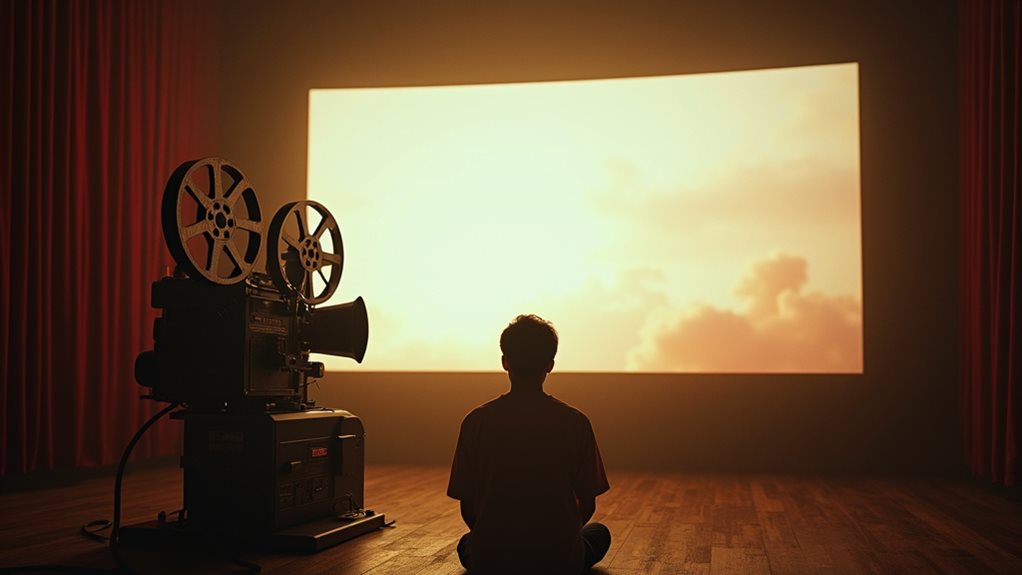
Your mind projects a continuous movie made from habits, expectations and past scenes, and you’re the audience and director. Your brain predicts what comes next, fills gaps with memories, and tags emotional moments for replay, so intrusive loops mean unresolved importance, not weakness. Labels and genres—trauma, threat, romance—skew attention and meaning. You can pause, reframe sensory details, and rehearse new endings to shift the script. Keep going and you’ll find edits to change what plays.
Key Takeaways
- Identify recurring scenes and emotions—these intrusive replays reveal unresolved events and the film your mind habitually projects.
- Notice genre labels (trauma, romance, threat) your mind assigns; labels steer attention, meaning, and emotional responses.
- Test evidence versus interpretation by pausing and asking what facts support the scene versus your narrative overlay.
- Reframe scenes by changing perspective, sensory tone, or ending, then rehearse new outcomes to weaken old neural patterns.
- Use daily micro-practices—visualization, grounding scents, and bedtime reviews—to retrain attention and script a more constructive inner film.
How Your Mental Movies Are Scripted

Although you don’t see the script, your brain writes it constantly from habits, expectations, and past experiences; neural networks weigh sensory input against stored patterns to predict what comes next.
You create narrative scaffolding that organizes perception into coherent plots, letting attention prioritize relevant cues.
Research shows predictive coding minimizes surprise by updating models, so memory casting fills gaps with plausible details drawn from past learning.
You can notice and revise these scripts by testing assumptions, seeking disconfirming evidence, and practicing alternative interpretations.
That analytical, compassionate approach reduces rigid reenactment and frees you to author more adaptive mental stories.
Why Scenes Keep Playing on Loop
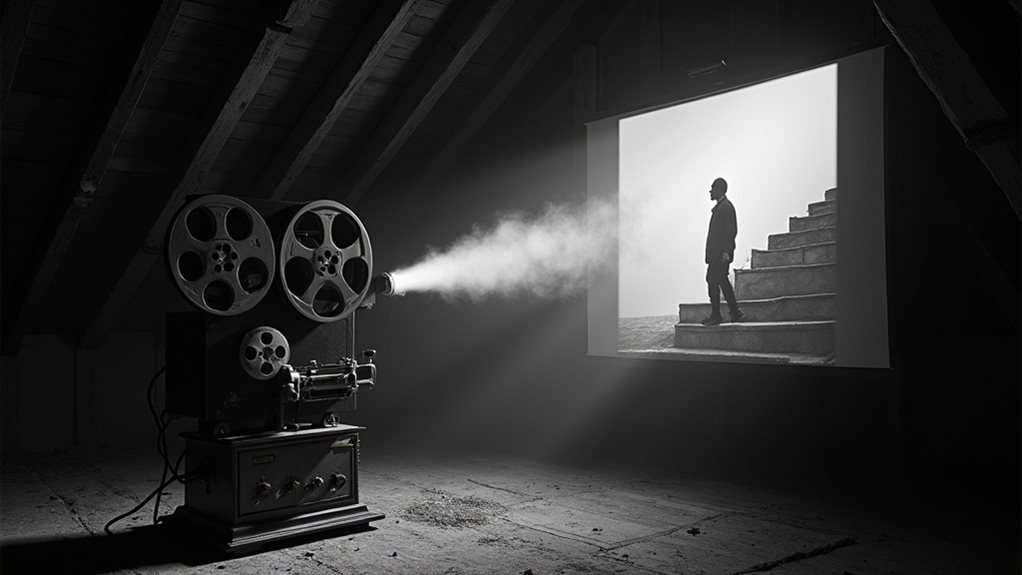
When a scene keeps replaying in your mind, it’s not just stubborn memory—it’s your brain signaling that something important went unresolved.
You experience intrusive memory replay because neural circuits tag emotional events for prioritization; repetition strengthens synaptic patterns. Repetitive triggers—smells, phrases, places—reactivate those circuits, biasing attention and mood. You aren’t stuck from weakness but from adaptive systems seeking resolution or learning. Assess patterns: what cue provokes replay, what need remains unmet, what corrective experience could update the trace? Clinically informed strategies—contextualization, rehearsal with new outcomes, grounding—reduce looped scenes by reshaping associations and diminishing automatic reactivation. You can regain control.
Genre Matters: How Labels Shape Your Experience

Think of your mind as classifying scenes into genres—trauma, romance, comedy, threat—and notice how those labels steer what you pay attention to and how you feel about an event.
You use Narrative Framing; Identity Labels make you protagonist or victim. Evidence shows labels bias attention, memory, and emotion. Notice automatic genre tagging; observe patterns without altering facts.
Imagine:
- Flashback in gray
- First date sunrise
- Stumble played for laughs
- Stranger in dark alley
- Mirror showing self
This perspective, grounded in research, helps you make more measured meaning of events now. Awareness reduces reactivity and widens choice.
Practical Editing Techniques to Reframe Scenes
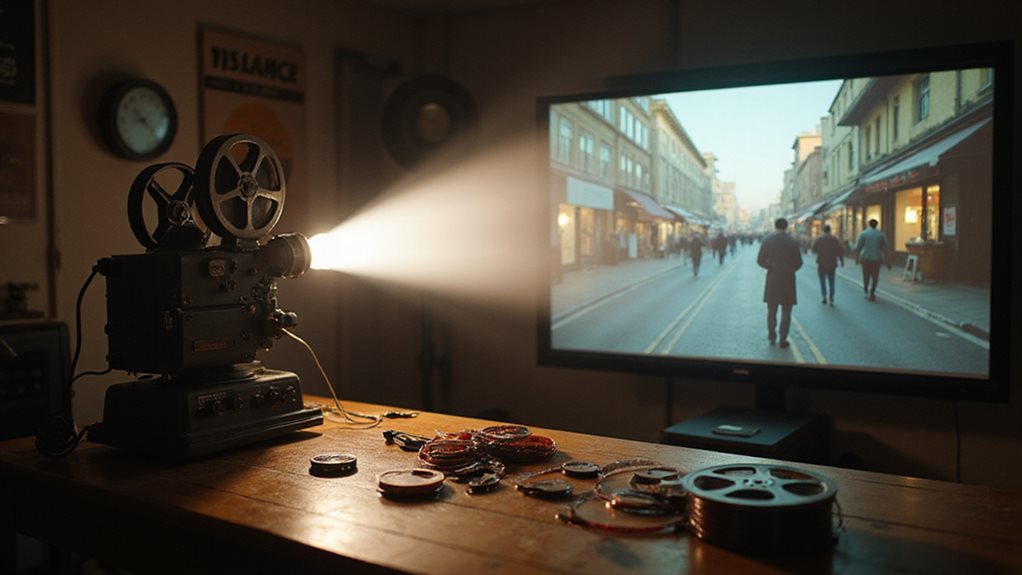
Because your brain records scenes with biases and habits, you can use concrete editing techniques to change how a memory or moment plays and how you respond.
When you pause, reframe elements—zoom out for context, alter time sequencing, or swap narrator tone—to produce perspective shifts supported by cognitive research.
Use sensory tweaking: soften sounds, brighten colors, or attenuate smells in imagination to reduce emotional intensity.
Label evidence versus interpretation, test alternate endings, and note behavioral consequences.
These concise, empirical edits shift appraisal patterns, helping you respond more adaptively without denying facts, increasing psychological flexibility and resilience over time reliably.
Directing Your Inner Cinema: Daily Practices
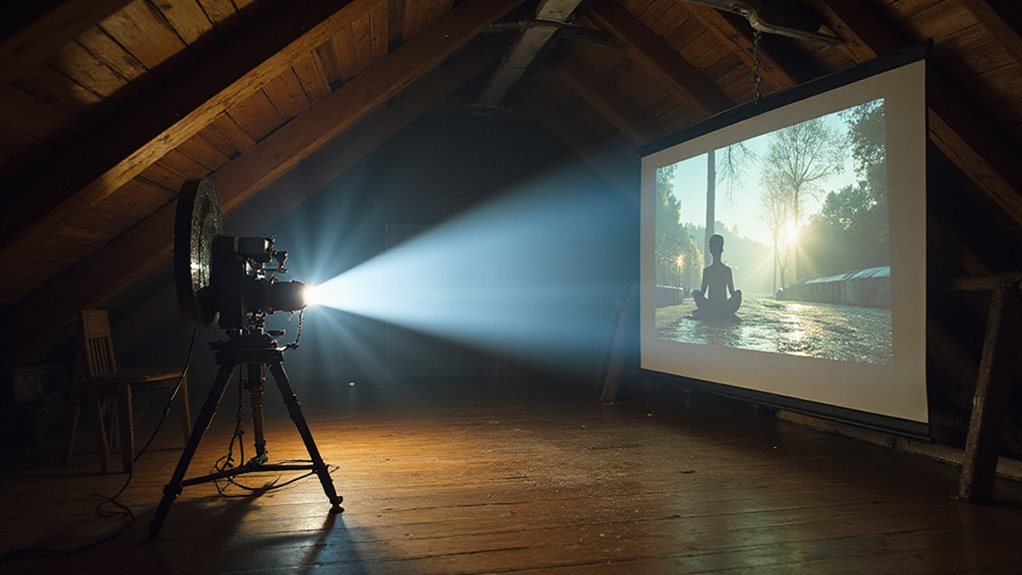
Often you’ll get the most change from small, consistent routines that train how you stage memories and moments.
You’ll direct inner cinema by choosing brief daily practices grounded in mindful rehearsal and sensory anchoring, supported by research showing habit drives neural plasticity.
Start simple, measure effects, iterate.
Use these scenes as rehearsals to shift tone and response:
- Morning visualization: vivid sights, sounds.
- Anchor with scent to cue calm.
- Reframe a tense memory as a short scene.
- Practice micro-responses repeatedly.
- Review day’s highlights before sleep.
These steps are practical, evidence-based, and tailored to your pace.
Change accumulates reliably over time.
Frequently Asked Questions
Can Medication Alter the Content of My Mental Movies?
Yes, medication can alter your mental movies: through neurochemical modulation it changes mood and perception, so you’ll notice narrative shifts in focus, intensity, and interpretation; studies show measurable effects, though responses vary across individuals widely.
Are Children’s Mental Movies Different From Adults’?
Yes, children’s mental movies differ from adults’, they’re often richer in imaginary companions and sensory vividness, reflecting developmental imagination, limited real-world schemas, and emotional learning; you’re likely to see fluid, fantastical scenarios than in adulthood.
How Do Cultural Backgrounds Shape Mental Movie Themes?
Cultural backgrounds shape your mental movie themes by seeding collective narratives and framing identity scripts, so you’ll interpret events through shared values, symbols, and memories, and researchers find these patterns influence perception, goals, and relationships.
When Should I Seek Professional Help for Distressing Mind Movies?
One in five people experience mental health issues; seek counseling when intrusive mind movies impair your sleep, work, relationships, or cause hopelessness, distress, or suicidal thoughts, and access crisis intervention if you’re at immediate risk.
Can Technology or VR Hijack My Inner Cinema?
Yes, technology—especially VR—can hijack your inner cinema: you’ll experience virtual distraction and deep simulated immersion that reshape attention, memory, and emotion; research shows repeated exposure alters neural pathways, so monitor use and set firm boundaries.
Conclusion
You’re the director of your inner cinema, so start noticing recurring scenes and choosing cuts that serve you. Research shows about 60% of repetitive negative thinking predicts future distress, so visualize swapping gloomy reels for hopeful ones to reduce that loop. Use brief, daily edits—mindful pauses, cognitive reframing, small behavioral experiments—and track changes; with consistent practice you’ll shift genre, regain agency, and create a clearer, kinder narrative for your life and sustain meaningful wellbeing daily.