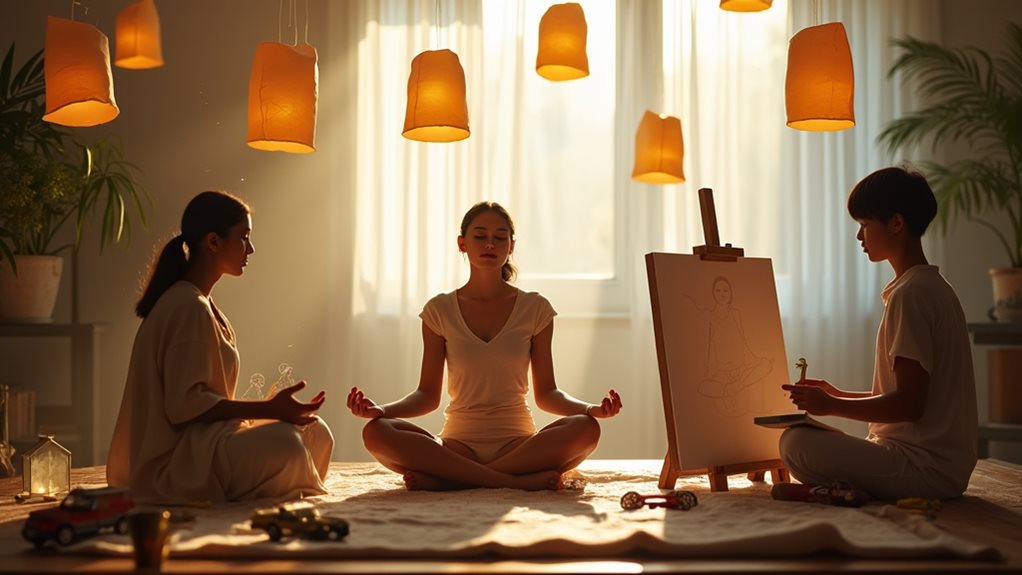
Pick a clear present-tense goal and paint it with senses — colors, sounds, smells, textures — for 2–5 minutes so your mind sees it as real. Do three daily 5–10 minute micro-practices: 2 minutes breath, 3–5 minutes sensory visualization, 30–60 seconds mantra, then jot one tiny action to do within 24 hours. After one practice, free-write 5–10 minutes to pull out image cues and baby-step actions. Keep this up and you’ll find practical next steps unfolding.
Key Takeaways
- Create a present-tense sensory goal sentence with measurable specifics and one anchoring emotion to make the outcome feel real now.
- Use a 5–10 minute daily micro-practice: 2 minutes breath, 3–5 minutes sensory visualization, 30–60 seconds mantra, then one tiny action.
- After visualization, do a 5–10 minute timed free-write capturing vivid sights, sounds, smells, touches, and extract 3–5 image cues.
- Build short scene snippets from image cues and rehearse them in future micro-practices to strengthen subconscious associative links.
- Track daily entries (date, mantra, vivid detail, tiny action) and pin sensory images to a vision board for consistent external anchoring.
Determine What You Want Through Sensory Visualization

When you want something clear, say it in one present‑tense sentence and let your senses fill in the details—see the room, hear the sounds, smell the air, feel textures, and even notice tastes—so your brain can picture the goal as if it’s already happening.
Start by crafting a present‑tense goal, then spend 2–5 minutes naming sensory details: colors, sounds, temperatures, numbers.
Add measurable specifics and anchor the image with an emotion word to boost subconscious engagement.
Practice Creative Visualization as daily practice, use a short mantra refocus when distracted, note one actionable step, and pin elements to a vision board.
Daily Micro-Practices: Routine, Mantra, and Tiny Actions
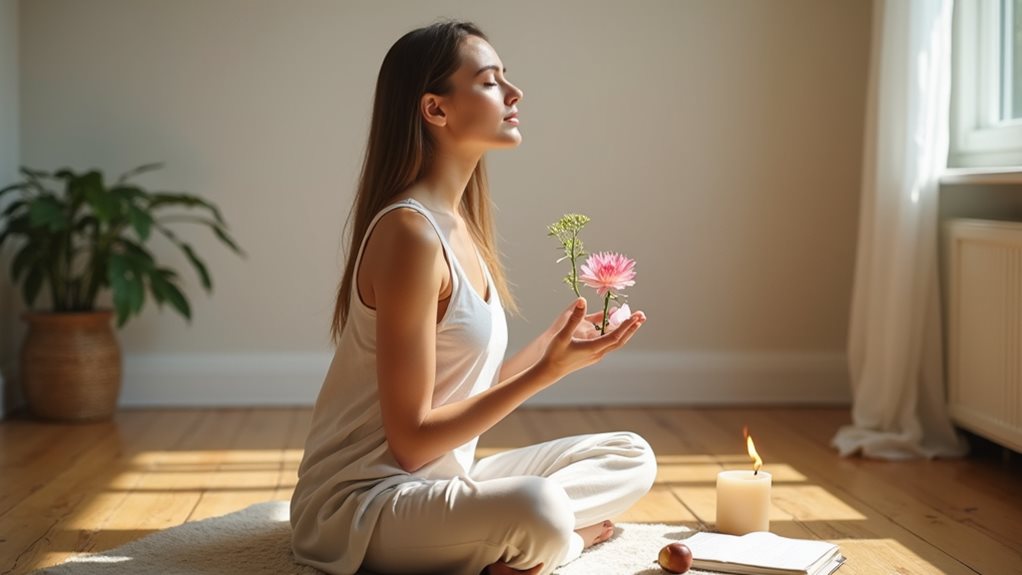
Regularly spending 5–10 minutes each day on a focused micro-practice will train your imagination and turn intention into movement.
Spend 5–10 focused minutes daily to train your imagination and convert intention into small, consistent action.
You sit in a consistent space, begin with breath-centered relaxation for two minutes, then use sensory-rich Visualization in present-tense for three–five minutes, ending with a short mantra for 30–60 seconds.
Immediately note one tiny action you’ll do within 24 hours, then record date, mantra, a vivid sensory detail, and that tiny action in a habit tracker or journal.
Treat this daily micro-practice as nonnegotiable training to build momentum and quiet the inner critic.
- Breath-centered relaxation
- Sensory-rich Visualization
- Tiny action + journal entry
Free Writing and Scene-Building to Solidify Intention
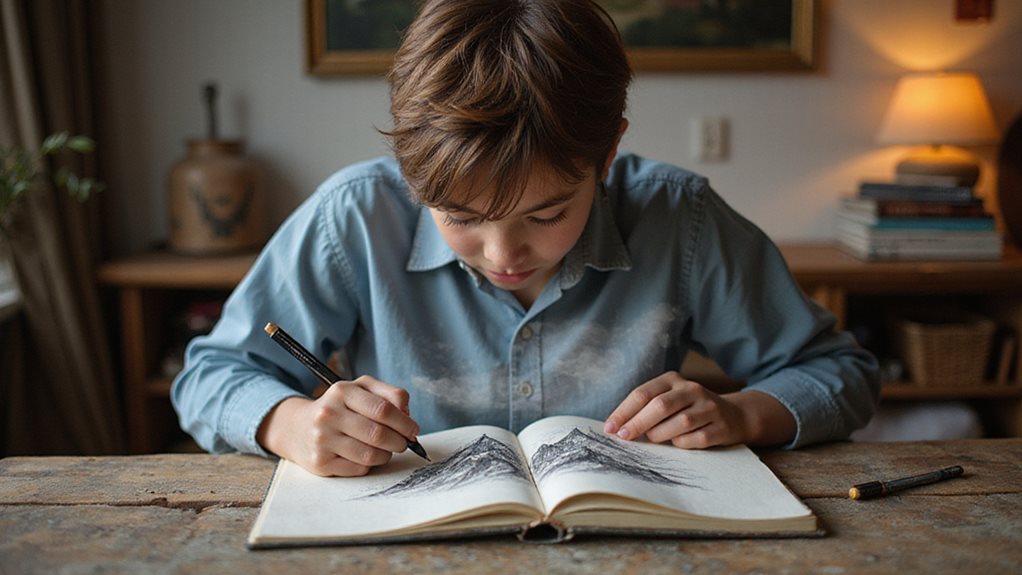
With a short visualization to anchor your intention, dive straight into a timed free-write: set 5–10 minutes, don’t edit, and pour out whatever sensory details and emotions arise—sight, sound, touch, even smell—to generate raw material you can shape into scenes. Use a concrete prompt, push for sensory-rich micro-scenes, then extract 3–5 image cues. Build short scene-building snippets for mental-rehearsal and note one baby-step action.
| Prompt | Sense Focus | Cue |
|---|---|---|
| Stage debut | sight, sound, touch | applause |
| First book | smell, sight, sound | ink |
| Pitch meeting | sound, touch, sight | handshake |
| Morning run | touch, smell, sight | breeze |
Frequently Asked Questions
How to Use Imagination for Manifestation?
You use imagination by scene crafting: do mental rehearsal with sensory amplification, micro visuals and emotion tuning, practice role embodiment, symbolic scripting and future journaling, employ narrative looping, invert constraints, then take a baby-step action daily.
How to Do Visualization for Manifestation?
You visualize by sensory anchoring, spatial mapping, and emotion amplification: future journaling with micro scripting, role embodying and symbol crafting, temporal staging and context switching, then habit pairing to translate images into action — you’ll feel it.
How to Practice Creative Imagination?
You practice creative imagination by daily sensory expansion and story sequencing: try role reversal, object personification, mood mapping, constraint play, imaginary dialogues, alternate endings, random prompts and micro fantasies, staying structured, visual, encouraging, and action-oriented.
How Can I Manifest My Goals?
Write, visualize, act: you align belief alignment with future scripting, use sensory amplification and emotional anchoring, place symbolic objects, practice subconscious dialogue through creative journaling, do mental rehearsal with intention timing, and build habit scaffolding daily.
Conclusion
You’ve practiced sensing your goal, built tiny daily rituals, and used free-writing to sketch the life you want — now what? Keep returning to those vivid images each morning, repeat a short mantra, and take one small action that proves you believe in the scene you’ve written. Stay gentle but consistent: habits compound, and imagination anchors intent. Trust the process, tweak along the way, and watch how focused practice begins to pull your goals into reality.